


Garage Golf Simulators: The Ultimate Guide to Building a Golf Simulator in Your Garage
Thinking about putting a golf simulator in your garage? You’re not alone — garage golf simulators are one of the most popular (and practical) ways to bring golf home, especially for homeowners looking for professional golf simulator installation in Florida, New York, and New England.
Whether you’re planning a garage golf simulator installation in Florida, a cold-weather build in New York, or a four-season setup anywhere in New England, this guide breaks down everything you need to know — from space requirements and garage door considerations to power, temperature, and realistic setup limitations.
We’ll keep it honest, helpful, and just a little bit fun — because hitting drivers in your garage should feel exciting, not stressful.
Why a Garage Golf Simulator Makes Sense
A garage golf simulator is often the easiest and most cost-effective way to get a full indoor golf setup without giving up living space inside your home.
This is especially true for homeowners looking for golf simulator installers in Florida, New York, and across New England, where basements aren’t always ideal and spare rooms rarely have enough ceiling height.
Why garages work so well:
- Higher ceilings than most spare rooms
- Concrete floors that support heavy simulator equipment
- Easy access for electrical upgrades
- Keeps golf gear out of main living areas
That said… garages come with a few unique challenges. Let’s walk through them.

How Much Space Do You Need for a Garage Golf Simulator?
Space is the #1 question people ask when planning a garage golf simulator installation.
Minimum Recommended Garage Dimensions
For a comfortable garage simulator experience:
- Width: 10–14 feet (wider is always better)
- Depth: 16–18 feet (ball‑to‑screen distance + swing clearance)
- Ceiling height: 9–10 feet (10 ft preferred for driver swings)
These recommendations apply whether you’re installing a simulator in Florida, New York, or anywhere in New England.
If you’re tight on space, don’t worry — experienced golf simulator installers can often make smaller garages work with the right enclosure and launch monitor selection.
You’ll Likely Lose at Least One Parking Spot (Yes, Really)
Let’s address the elephant in the garage.
In almost all cases, a garage golf simulator will require sacrificing at least one car bay.
- Single‑car garage → simulator takes the entire space
- Two‑car garage → one bay for golf, one bay for the car (best‑case scenario)
- Three‑car garage → living the dream
While retractable setups exist, most professional garage golf simulator installations in Florida, New York, and New England are semi‑permanent or permanent builds.
Pro tip: Most golfers stop caring about parking indoors after about three simulator sessions.

Garage Door Track & Opener Considerations (A Big One)
Garage door hardware is one of the most overlooked — and most important — parts of planning a garage golf simulator.
Common Garage Door Issues
- Door tracks hanging into swing space
- Traditional openers mounted directly above the hitting area
- Horizontal rails blocking projector mounting
Common Solutions Used by Professional Installers
- High‑lift garage door tracks
- Side‑mounted (jackshaft) garage door openers
- Locking the garage door in the open position
These upgrades are extremely common in garage golf simulator installations in New York and New England, where ceiling height is often tighter than in Florida homes.

Why Enclosures Work Better Than Custom Built‑In Screens in Garages
Unlike basements or dedicated simulator rooms, garages rarely have two parallel walls close enough together to support a true custom built‑in impact screen.
This is why nearly every professional garage golf simulator installer recommends an enclosure‑based setup.
✅ Golf Simulator Enclosures Are the Realistic Choice
Garage golf simulator enclosures:
- Don’t rely on wall‑to‑wall mounting
- Work around garage doors and uneven wall spacing
- Are safer and easier to install
- Allow for future adjustments or relocation
Trying to force a custom framed screen into a garage often leads to poor screen tension, ball ricochet risks, and regret — regardless of whether the install is in Florida, New York, or New England.

Noise, Safety & Ball Containment
Garages echo. A lot.
To protect your home and keep everyone happy:
- Use side netting or enclosure wings
- Add wall and ceiling padding near the hitting zone
- Consider sound‑dampening panels
This is especially important for attached garages common in New England and New York homes.

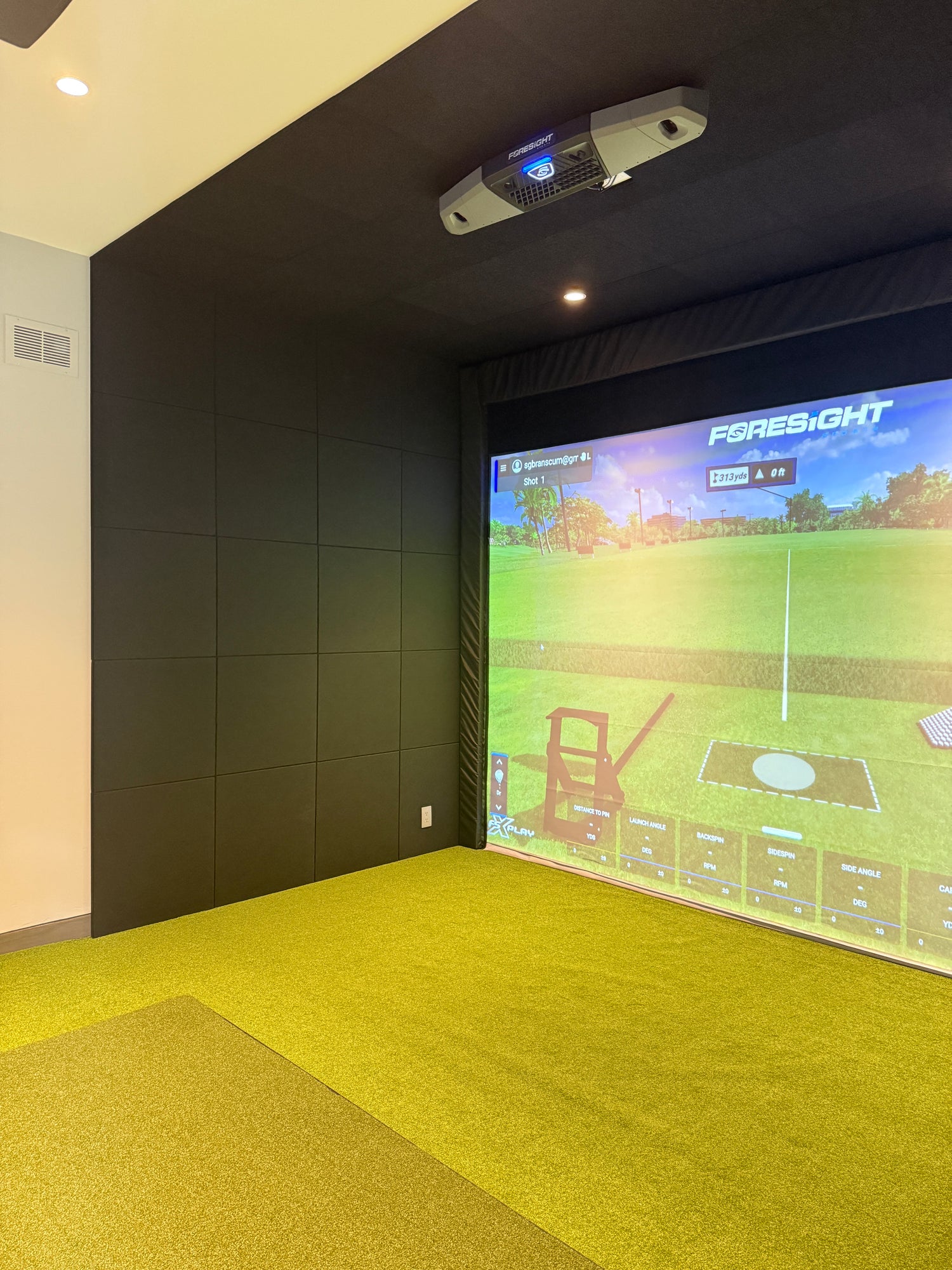
Projector & Launch Monitor Placement in a Garage
Garage golf simulators typically work best with:
- Short‑throw or ultra‑short‑throw projectors
- Ceiling‑mounted or side‑mounted launch monitors
Professional golf simulator installers in Florida, New York, and New England plan carefully around:
- Garage door rails
- Limited ceiling mounting zones
- Golfer shadows and swing path clearance
Choosing garage‑friendly equipment is critical — not all projectors or launch monitors are ideal for garage environments.
Temperature & Climate Control in a Garage Golf Simulator
Garages aren’t known for being climate‑controlled — and climate matters a lot for simulator electronics.
Regional Temperature Considerations
- Florida garage golf simulators: heat and humidity protection is critical
- New York & New England garage golf simulators: cold temperatures can affect PCs, projectors, and launch monitors
Common Climate Solutions
- Mini‑split HVAC systems
- Proper insulation for walls and garage doors
- Controlled space heaters (used safely)
If you’re searching “can a golf simulator be used in a cold garage in New England?” or “can a golf simulator handle Florida heat?” — the answer is yes, with proper planning.
Electrical & Power Requirements
A professional garage golf simulator installation requires more power planning than most homeowners expect.
Typical Electrical Needs
- Dedicated outlet for the projector (often ceiling‑mounted)
- Outlet for the launch monitor
- Power for a gaming PC or console
- Optional dedicated circuit for high‑end setups
Many garages — especially in older New York and New England homes — need electrical upgrades to safely support a simulator.
Clean wiring and proper outlet placement separate a professional install from a DIY science experiment.

Is a Garage Golf Simulator Worth It?
Absolutely.
A professionally installed garage golf simulator offers:
- Year‑round practice
- Incredible convenience
- Strong resale appeal
- More golf without leaving home
With the right design, a garage simulator can feel just as immersive as a dedicated indoor golf room — whether you’re in Florida, New York, or anywhere in New England.
Final Thoughts: Build Smart, Swing Free
Building a golf simulator in your garage is one of the most rewarding upgrades a golfer can make — as long as it’s designed for the realities of garage spaces and regional climate.
Focus on:
- Proper space planning
- Garage door and opener modifications
- Enclosure‑based setups
- Electrical and temperature control
Do that, and your garage golf simulator won’t feel like a compromise — it’ll feel like your favorite room in the house.
If you’re planning a garage golf simulator installation in Florida, New York, or New England, we’re here to help you design the right setup and choose the right equipment.
(And yes — your car will survive the driveway.)
Let's Get Your Project Started
Turn your garage into your personal driving range and country club. Whether you're a weekend warrior looking to shave strokes off your game or a serious golfer who refuses to let weather kill your practice routine, we've got you covered.
Frequently asked questions
How much space do I need for a simulator? Will it fit in my house?
To set up a golf simulator, you need to consider the height, width, and depth of the room.
- Ceiling Height: Ideally, you need at least 9 to 10 feet of ceiling height to swing a golf club comfortably, especially for taller players or those with a high swing. A height of 10 feet is generally recommended for maximum flexibility.
- Room Width: For the width, 12 feet is a common recommendation, allowing enough space for both right- and left-handed golfers to swing comfortably without hitting the walls.
- Room Depth: The room should be at least 15 feet deep, which allows space for the golfer to stand, the screen, and the projector or monitor setup. This distance also provides enough room for the ball to travel and the simulator to capture accurate data.
Have more questions or have a specific situation you need to ask about? Contact our team today. Our phone number is 813-463-8279 and our email is golf2ubiz@gmail.com
Will my simulator have other uses? Can I use it as a theatre room or for other sports?
Absolutely! Your entertainment space is about more than just golf.
Fortunately, we've use industry leading screens to withstand impacts from just about anything you can throw (or kick) at it. Further, your projector setup can serve double duty as a home theatre system, a larger than life workout app display, or immersive video game experience unlike anything you’ve ever seen.
Have more questions or have a specific situation you need to ask about? Contact our team today. Our phone number is 813-463-8279 and our email is golf2ubiz@gmail.com
What courses can I play on my golf simulator?
LOTS!
Most golf simulators offer a wide range of virtual courses, including world-famous PGA Tour courses, classic championship layouts, and even fictional or user-designed courses. The specific selection depends on the simulator software you’re using.
Some of the most popular real-world courses you can play include:
- Pebble Beach (available on TrackMan and TGC 2019)
- St. Andrews Links (on TrackMan, E6 CONNECT, TGC 2019)
- Whistling Straits (on TGC 2019)
- Bethpage Black (on E6 CONNECT and TGC 2019)
- TPC Sawgrass (on E6 CONNECT and TGC 2019)
- Royal St. George’s (on TGC 2019)
- Pinehurst No. 2 (on TrackMan, E6 CONNECT)
- Spyglass Hill (on TrackMan)
Some software, like TGC 2019, offers over 170,000 courses, including user-created ones, while others, such as E6 CONNECT, focus on high-quality recreations of around 90 courses. TrackMan and GSPro also offer excellent course selections and realistic gameplay. You'll want to discuss computer requirements with our team to make sure you have everything you need.
Our phone number is 813-463-8279 and our email is golf2ubiz@gmail.com
Have more questions or have a specific situation you need to ask about? Contact our team today. Our phone number is 813-463-8279 and our email is golf2ubiz@gmail.com
How much will my golf simulator cost and how fast can you build it?
Because Golf2U’s solutions are tailor made to your needs, it can be impossible to predict how long your build will take from start to finish. We'll do our best to set clear expectations about the complexity and timing of your build once we've gathered all your requirements. As a general rule, once we've agreed on a design, you can expect 3-4 weeks to make/gather your materials and execute your build.
Have more questions or have a specific situation you need to ask about? Contact our team today. Our phone number is 813-463-8279 and our email is golf2ubiz@gmail.com
Can a golf simulator help me improve my game?
Yes! A golf simulator can significantly improve your golf game. Here's how:
1. Practice Year-Round
A golf simulator allows you to practice your swing regardless of weather or season. With consistent, year-round practice, you can improve your muscle memory, swing mechanics, and overall consistency.
2. Data-Driven FeedbackSimulators provide real-time data on every shot, including ball speed, club speed, launch angle, spin rate, and shot dispersion. Analyzing these metrics helps you understand and adjust specific aspects of your swing, like your angle of attack, clubface alignment, or swing path. For example, systems like TrackMan and SkyTrak offer in-depth insights into your ball flight and performance.
3. Course Management
Playing virtual rounds on famous courses helps improve your course management skills. You learn how to approach different types of shots, manage hazards, and make better decisions on club selection. Many simulators allow you to practice on replicas of real-world courses, giving you a better understanding of how to navigate challenging layouts(Golfstead).
4. Targeted Practice
Most golf simulators offer practice modes that allow you to focus on specific aspects of your game, such as driving, iron play, or putting. You can practice in a controlled environment, repeat shots from the same position, and work on weak areas like bunker play or approach shots.
5. Mental Focus and Strategy
Regular simulator practice builds mental toughness by mimicking pressure situations, such as hitting a shot to a small target or making a crucial putt. This can translate into more focus and confidence during real rounds of golf.
By offering detailed feedback, unlimited practice opportunities, and simulations of real-world courses, a golf simulator is an excellent tool for improving your game
How can i convince my wife to let me have a golf simulator?
1. Tell her it's a movie room
2. Get your kids into golf
3. Tell her it'll mean less golf trips and that you'll be home more
How much does a golf simulator cost
We're not trying to be cagey with this answer but.... IT DEPENDS! There are about 10 different components that make up the simulator which will dictate your overall cost. The biggest two things that will determine the cost of your simulator are 1. Which launch monitor you choose and 2. Whether you go with a custom built-in screen or an enclosure.
Give us a call and we'll give you a quote!
CUSTOM SOLUTIONS FOR ANY SPACE
From compact condo setups to full garage transformations, we design golf simulators that maximize your available space
LOCAL Florida | New England | New York EXPERTS
We live here, play here, and install here. Our team understands Florida, New England, and New York homes, weather challenges, and what local golfers need to stay sharp year-round.
WHITE GLOVE INSTALLATION
From permits to final calibration, we handle every single detail so you don't have to. Our team coordinates electrical work, manages installations, and trains you on your new system.